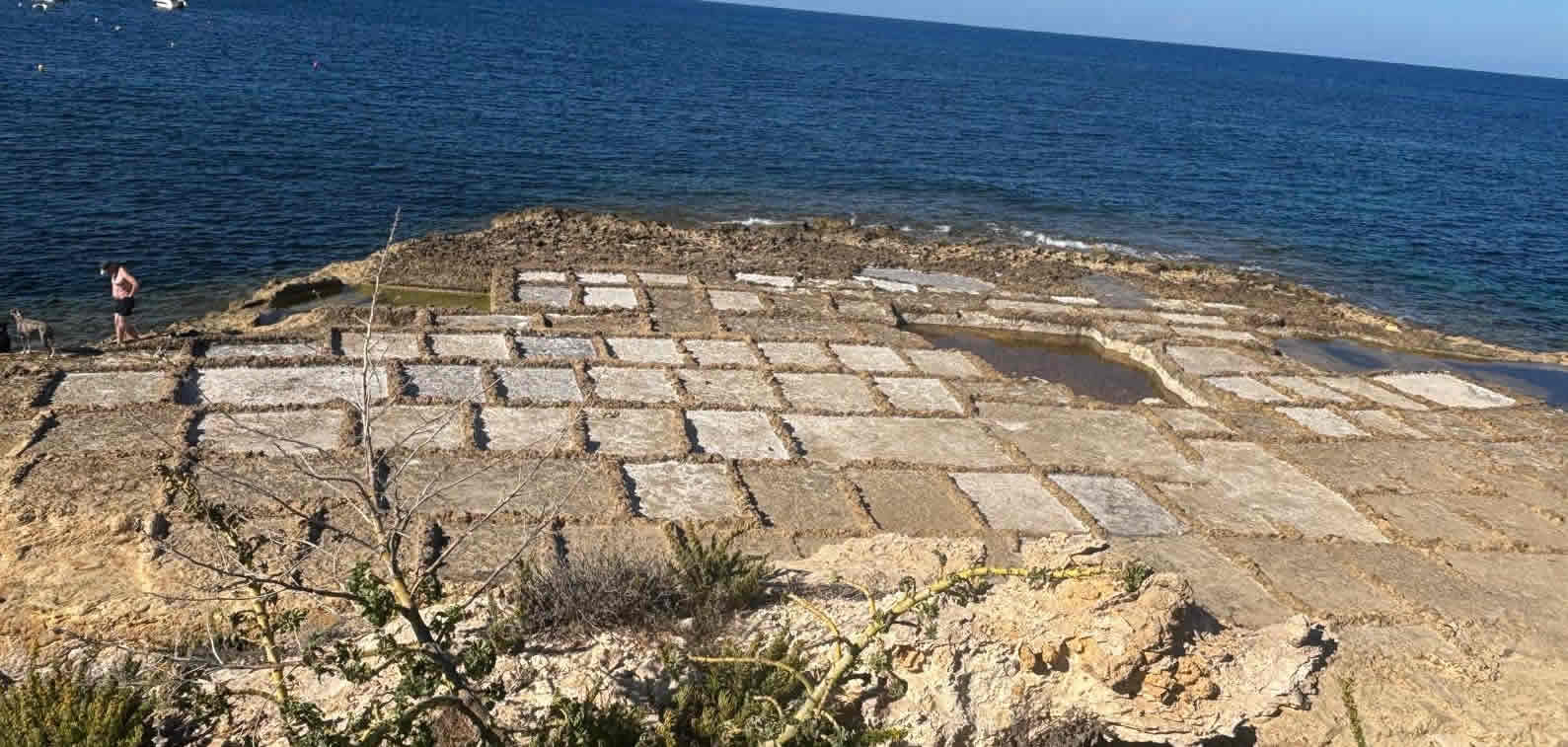
The Qbajjar Salt Pans are one of the main clusters of traditional salt works on Gozo’s north coast, forming part of the large salt-harvesting zone stretching from Marsalforn to Xwejni.
📜 Historical Background
Ancient origins: Like other Maltese salt pans, the ones at Qbajjar likely date back to Roman times or earlier, when coastal rock pools were deliberately shaped to harvest salt.
Knights of St John period (16th–18th c.): Salt was a state-controlled commodity, taxed and leased by the Order. The Qbajjar pans were part of the wider Marsalforn/Qbajjar salt works, which were systematically expanded during this era.
18th century military presence: The nearby Qolla l-Bajda Battery (1715–1716) overlooked both Qbajjar Bay and the salt pans, underlining how strategic and valuable salt production was to the island’s economy.
📍 Location
🏗️ Physical Layout
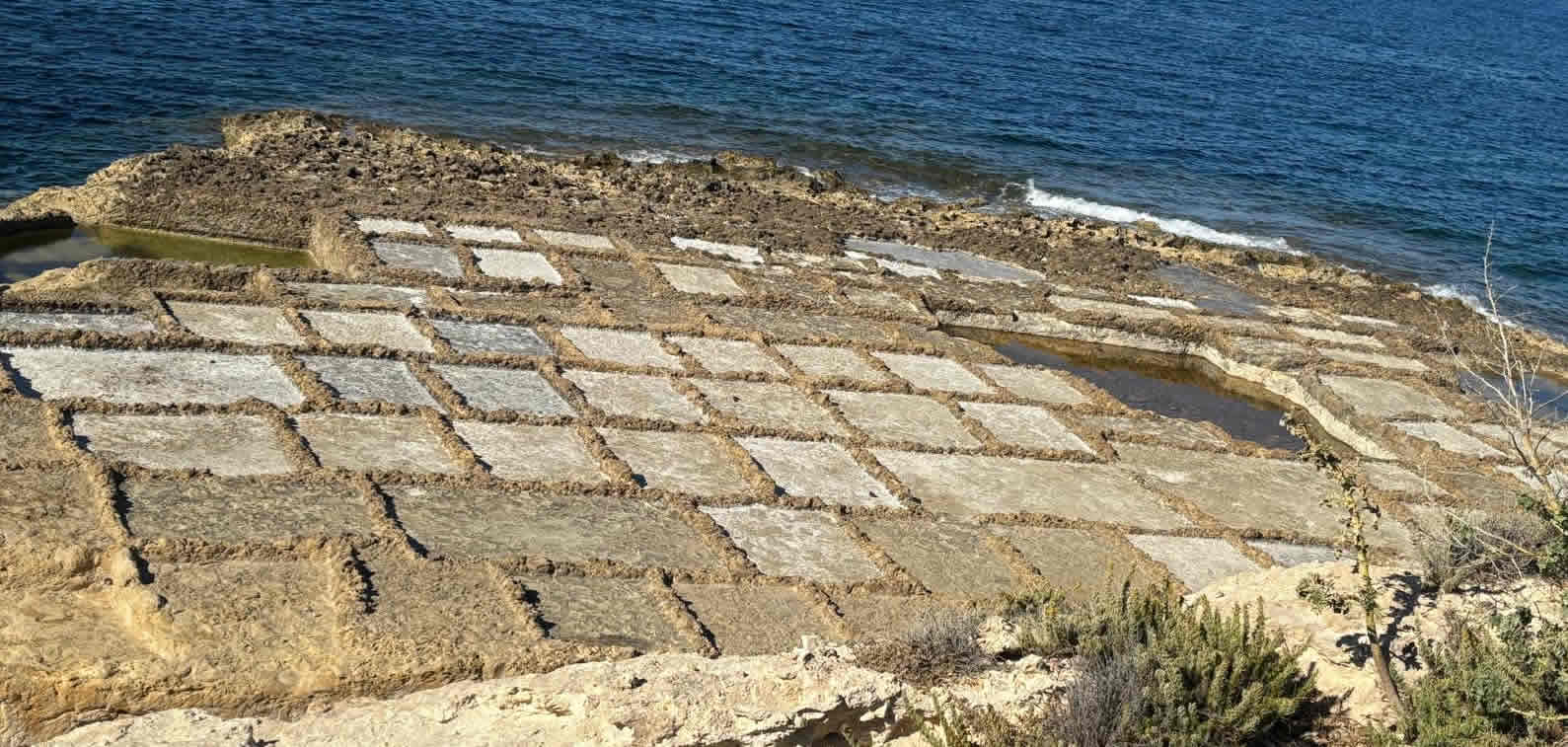
The Qbajjar pans are cut into the limestone rock along the flat foreshore of Qbajjar Bay, stretching westward towards Xwejni.
Their grid is less extensive than Xwejni’s but more regular than the small pans under Qolla l-Bajda Battery.
The design uses a stepped process:
1. Seawater enters collection basins by wave action or hand-channeling.
2. Water is transferred into shallower evaporation pans
3. Once crystallised, the salt is scraped, dried, and stored.
The location benefits from flat limestone platforms, summer heat, and steady breezes, making it efficient for evaporation.
⚒️ Economic & Social Role
Salt from Qbajjar (alongside Xwejni) supplied Gozo’s communities and was also exported to Malta.
Families from nearby villages (Żebbuġ, Marsalforn, and Għasri) traditionally managed specific stretches of pans, with knowledge passed down through generations.
Harvesting was seasonal: in summer, families would spend weeks by the shore, maintaining pans and gathering the salt.
⏳ Decline
In the late 19th–20th centuries, imported industrial salt reduced the demand for local production.
Many smaller and more exposed pans (like those right under Qolla l-Bajda Battery) were abandoned.
The Qbajjar pans survived longer but gradually declined in commercial importance, with activity concentrating at Xwejni, which remains Gozo’s main active site.
🌊 Present Day
The Qbajjar pans are partially active, with some still maintained by local families, though on a smaller scale than in the past.
They are valued as part of Gozo’s cultural heritage landscape, together with the Battery above and the nearby Marsalforn fishing village.
Heritage and environmental groups highlight them as a tourist attraction, offering visitors a view of a centuries-old craft still visible in the landscape.
Conservation challenges remain, as coastal erosion, urban development, and declining artisanal use threaten their long-term preservation.
✅ In summary
The Qbajjar Salt Pans date back centuries (likely Roman in origin, expanded under the Knights), were once a vital part of Gozo’s salt economy alongside Marsalforn and Xwejni, and are today partially active heritage pans, serving as a living link between Gozo’s working past and present.