Malta’s Prehistoric Heritage and Archaeological Sites
Interactive map showing the Megalithic Temples of the Maltese IslandsOverview
Malta's Neolithic period (roughly 5200–2500 BCE) produced one of Europe's most remarkable prehistoric monument traditions: freestanding megalithic temples and elaborate rock-cut sanctuaries. These structures—some older than Stonehenge and contemporary with ancient civilizations in the Near East—reflect complex social organization, ritual life, and skilled stone-working by communities who settled on the Maltese islands more than 7,000 years ago.
Landscape and context
Malta's strategic position—midway between Sicily and North Africa—made it a crossroads of Mediterranean seafaring. The islands' soft Globigerina limestone was ideal for carving, while the surrounding sea provided resources and routes for contact. Archaeologists divide Malta's prehistoric sequence into phases (Għar Dalam, Żebbuġ, Mġarr, Ġgantija, Tarxien) that reflect shifts in pottery, architecture, and burial practice.
Major temple sites
Below are the key temple complexes and what makes each site important.
Ġgantija (Gozo)
One of the oldest free-standing stone monuments in the world (c. 3600–2500 BCE). Its massive megaliths and multi-hall plan suggest communal ritual architecture and long-term monument construction projects.

Ħaġar Qim & Mnajdra (Qrendi)
Clifftop temples with rich sculptural detail and alignments: Mnajdra's solar orientations have attracted scholarly attention for possible calendrical functions.

The ancient structure is made of massive, weathered, golden-brown Globigerina limestone blocks.

The ancient ruins are constructed from weathered, golden-brown limestone blocks and rough stones, all preserved under a modern protective shelter.
Tarxien (Ħal Tarxien)
Known for finely carved stonework and decorated slabs, Tarxien shows elaborate ritual installations and sophisticated use of space.

Ħal Saflieni Hypogeum (Paola)
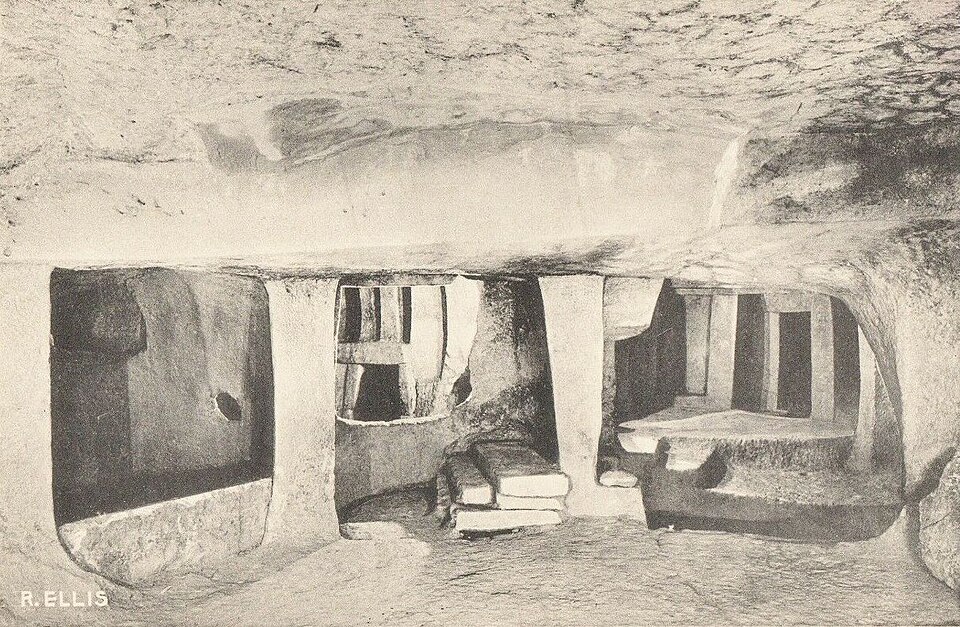
Underground necropolis and sanctuary carved in the rock with multiple levels and exceptional preservation of burial contexts and painted decoration.
Tip: Many of these temples are UNESCO World Heritage Sites. If you plan to visit, check opening times and booking requirements—some sites have restricted access to protect fragile interiors.
Quick timeline
Archaeological discoveries and methods
Excavations over the last two centuries revealed pottery sequences, carved stone altars, figurines (often interpreted as votive or ritual objects), animal and human remains, and complex stratigraphies. Modern approaches—radiocarbon dating, petrographic analysis of stone and pottery, microstratigraphy, and geophysical prospection—have refined chronologies and helped map buried features without invasive digging.
Key finds — figurines & iconographyFemale figurines and stylized animal motifs appear frequently. Scholars debate whether figurines indicate goddess cults, ancestor veneration, or other symbolic practices. Context matters—many were found in votive deposits or near altars.
Conservation & threats Salt crystallisation, visitor wear, and past restoration practices have damaged surfaces. Conservation focuses on environmental control, visitor limits, and careful restoration using compatible materials.
Interpretations and open questions
Researchers explore temple functions (ritual, communal, territorial markers), social organization required to build them, and possible links to agricultural cycles or astronomical observation. Questions remain about the social processes that ended the temple-building era around 2500 BCE.
Visitor information & suggestions
- Book tickets for sensitive sites (Ħal Saflieni Hypogeum requires advance booking because of limited capacity).
- Respect site rules: no flash photography or touching of exposed surfaces.
- Combine temple visits with local museums (e.g., National Museum of Archaeology in Valletta) to see artifacts and reconstructions.
Further reading & resources
This page is a starting point. For deeper study consult academic monographs, museum catalogues, and peer-reviewed journals on Mediterranean archaeology.
- Introductory books on Maltese prehistory (search local university libraries and museum catalogues)
- Recent archaeological reports and syntheses (look for journals specializing in Mediterranean archaeology)
- UNESCO & national heritage websites for site histories and visitor guidance
- 5200 BCE — First Neolithic settlements
- 3800–2500 BCE — Major temple phases
- After 2500 BCE — Cultural transformation
- Researcher: Paul Berman
- Last Updated: 2026
Author: Compiled by a cultural heritage content writer. Designed to be printable and mobile-friendly. If you'd like sources cited inline or a fully referenced academic version, I can add bibliographic citations and suggested readings.
At a glance
Period: c. 5200–2500 BCE — Main focus: megalithic temples, rock-cut sanctuaries, burial chambers.
Quick facts
UNESCO: Several temple complexes inscribed as UNESCO World Heritage Sites. Materials: Globigerina limestone. Typical plan: Apsidal (curved) multi‑hall temples.
Timeline snapshot
Suggested museums
National Museum of Archaeology (Valletta), Gozo Museum of Archaeology , site interpretation centres at Ħaġar Qim & Mnajdra.
Map & quick tour
For a 1-day focused tour: visit Ħaġar Qim & Mnajdra (Qrendi) in the morning, Tarxien in the afternoon, and finish with the archaeology galleries in Valletta. Add Ġgantija on Gozo for a full-day island trip.
Research & Documentation
This page forms part of eMalta's ongoing documentation of the historical, cultural and religious heritage of Malta and Gozo.
Information has been compiled through site visits, field research, historical publications, archival records, maps, plans and other reference sources.
All locations that currently exist featured on eMalta have been personally visited and documented. Where historic sites no longer exist, information has been researched from archival sources and contemporary records.
Images used on eMalta include original photography as well as historical illustrations, maps and photographs reproduced with permission from archives, institutions and copyright holders where applicable. Individual image credits and archive reference numbers are provided where available.